Trust is an essential elixir for public life and neighborly relations, and when Americans think about trust these days, they worry. Two-thirds of adults think other Americans have little or no confidence in the federal government. Majorities believe the public’s confidence in the U.S. government and in each other is shrinking, and most believe a shortage of trust in government and in other citizens makes it harder to solve some of the nation’s key problems.
Should we trust the government?
Many think it is necessary to clean up the trust environment: 68% say it is very important to repair the public’s level of confidence in the federal government, and 58% say the same about improving confidence in fellow Americans.
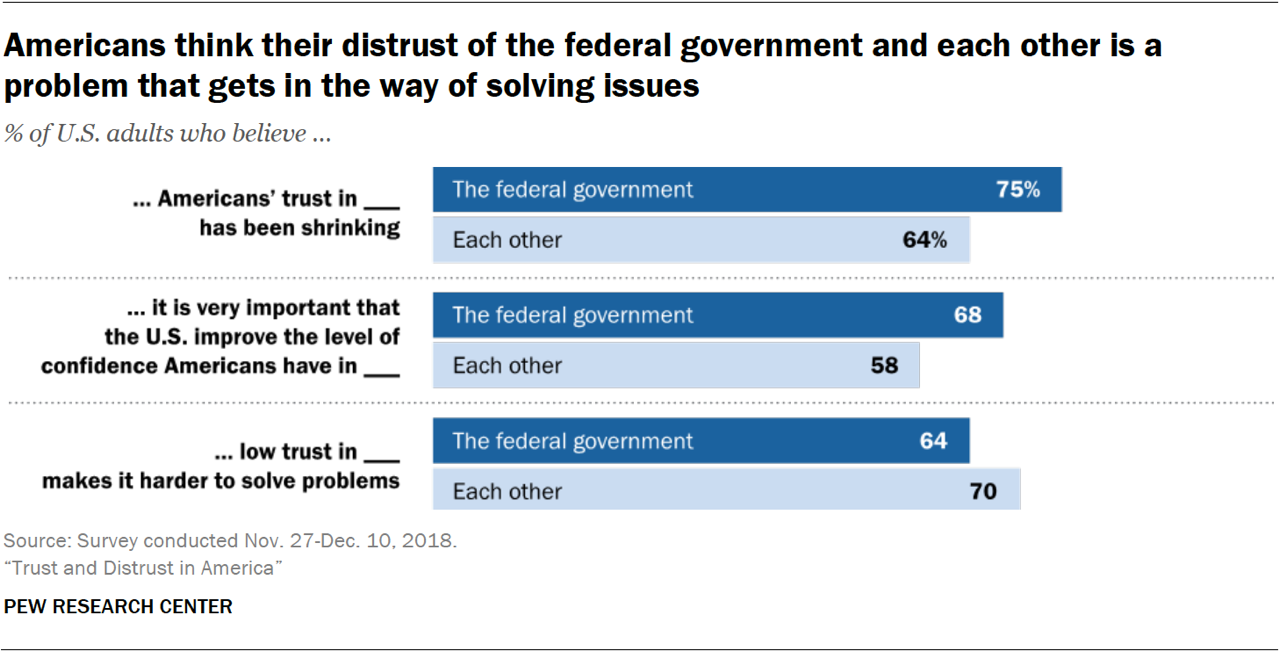
In a comment typical of the views expressed by many people of different political leanings, ages and educational backgrounds, one participant in a new Pew Research Center survey said: “Many people no longer think the federal government can actually be a force for good or change in their lives. This kind of apathy and disengagement will lead to an even worse and less representative government.” Another addressed the issue of fading interpersonal trust: “As a democracy founded on the principle of E Pluribus Unum, the fact that we are divided and can’t trust sound facts means we have lost our confidence in each other.”
For many of us these days, it feels as if the United States has never been less united. The nation, it seems, has become irrevocably fractured along political and ideological lines — Republican/Democrat, liberal/conservative, red/blue, etc. Sitting down for Thanksgiving dinner with family has never been more uncomfortable and the admonition to avoid discussing religion or politics in polite company has never been more apropos.
What has happened to America? And how can we reverse the trend?
First, we need to examine whether the country is divided or merely seems that way. Several articles have been written over the past few years reminding us that, despite the name, the US been divided for much of its existence (see Jonathan Rauch’s article at Brookings and Scotty Hendricks’ at Big Think). Indeed, it would be hard to argue that the country is more divided now than it was during the Civil War and in fact, the familiar proscription against discussing politics and religion in general company appeared at least as far back as a book of etiquette entitled Hill’s Manual of Social and Business Forms published in 1879. And it could certainly be said that our current political unrest has nothing on the 1960s. Consequently, part of today’s apparent divisiveness appears to be a matter of short-sighted perspective — many of us who feel that the nation has never been so split have only been politically conscious for a few decades and therefore have a narrow timeline from which to compare.
Still, there is good evidence that American political parties have become increasingly polarized over the past several decades, with Democratic and Republican politicians disagreeing over policy more than ever. Witness the headlines following the death of Senator John McCain last week — “John McCain and the Dying Art of Political Compromise” in the Wall Street Journal and “McCain’s Death Marks the Near-Extinction of Bipartisanship” at NPR. But what’s less clear is whether political party division reflects division within the general public and American culture at large. Suffice it to say that the evidence is… well, somewhat divided.
Collectively, these results indicate that it’s the social identifying role of ideological affiliation that’s paramount in guiding our negative emotional responses to those on the other side of the political fence. This conclusion helps us to understand a few seemingly puzzling aspects of politics today — for example, how politicians can “pivot” on the issues when running for office and how key components of traditional party platforms can sometimes turn on a dime (e.g. the GOP and Russia), and why hypocrisy seems to run rampant in politics today. For much of the voting public, political affiliation isn’t so much about the issues as it is about being part of “Team Red” and “Team Blue.” So opposed between “us” and “them,” “liberals become “libtards,” “conservatives” become “fascists,” and the possibility of finding common ground flies out the window. As NYU philosophy professor Kwame Anthony Appiah recently put it, “all politics is identity politics.”
Trends in media feed confirmation bias
On its own, the conclusion that we’re “ideologues without issues” doesn’t explain why political polarization has increased over the past several decades. But Dr. Iyengar’s study supplies a clue with the additional finding that increasing affect polarization was correlated with increasingly negative political campaigning over time. Noting the relationship between negative campaigning and press coverage, the study authors wrote that “negative (but not positive) messages are recycled ad infinitum by journalists who seek conflict and controversy above all else” and that “technology has facilitated citizens’ ability to seek out information sources they find agreeable and tune out others that prove dissonant.” In other words, campaign muckraking appears to increase affect polarization, while press coverage of that conflict fans the flame of confirmation bias.
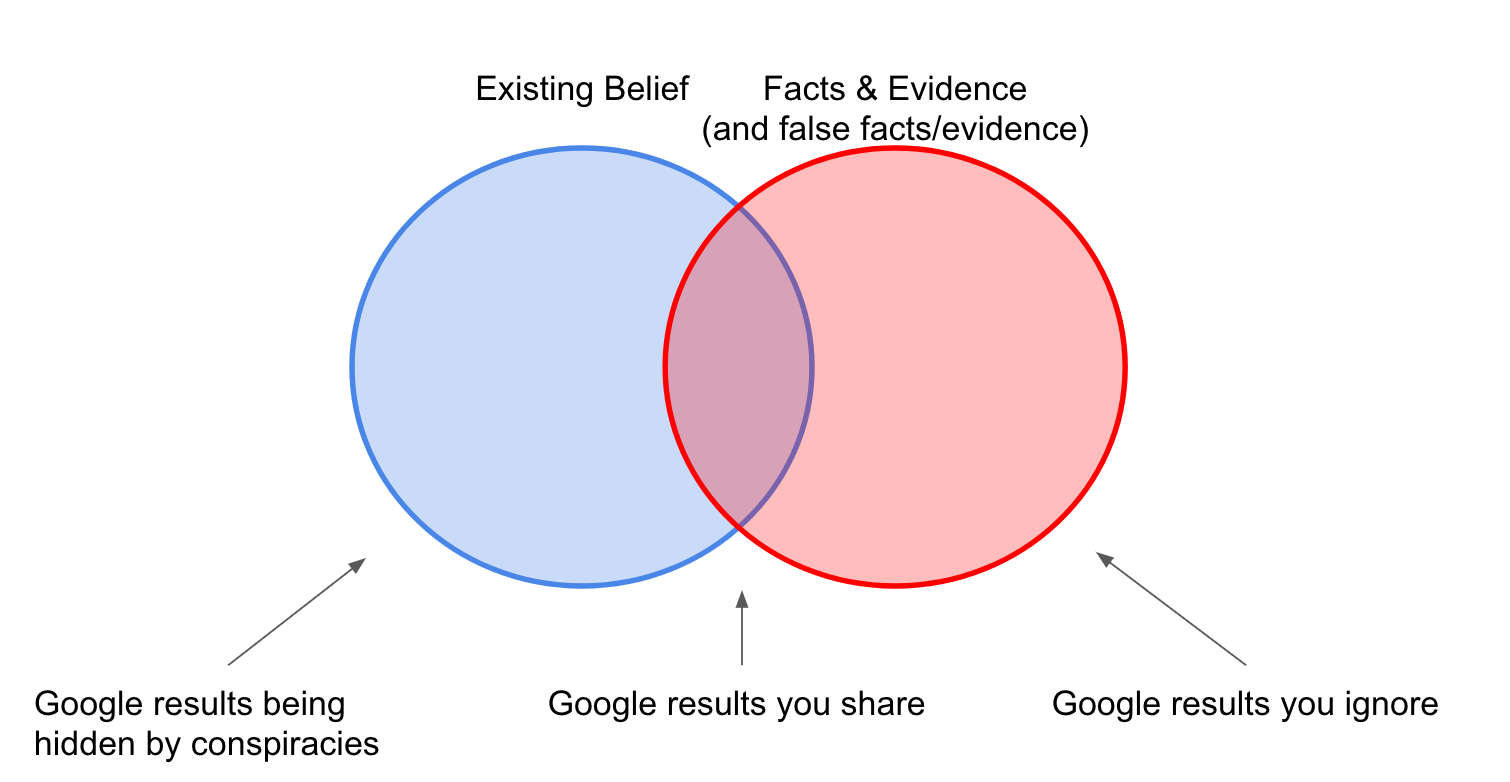
Confirmation bias is to belief formation as “location, location, location” is to real estate — it’s one of the most powerful determinants, if not the most powerful determinant, of how we consolidate beliefs when consuming information. Over the past several decades, the proliferation of cable news networks and options for online information, the increased intermingling of opinion and news, and a “click-based” revenue model that incentivizes sensationalism has resulted in a kind of “confirmation bias on steroids” for informational consumers. With Republicans relying on Fox News and Democrats on the likes of The Daily Show as the go-tos for their political news, no wonder disdain for members of the opposing party has run wild.
No discussion of modern political polarization is complete without mention of the contribution of Russian trolls and bots to fomenting American dissatisfaction with life in a multicultural democracy. It’s now well-established that Russia attempted to influence the results of the 2016 US Presidential Election though the propagation of online misinformation, though of course whether it did influence the election and to what extent collusion occurred and by whom remains a matter of partisan debate. Just this past month, a study was published the found that Russian bots on Twitter have also been weighing in on the debate over vaccines, with bots significantly more likely to Tweet about vaccines in general, with both pro- and anti-vaccination messages, than the average Twitter user.5 This finding is consistent with the theory that the intent of Russian trolls operating under the political direction of the Kremlin is to sow the seeds of American discord.
Coupled with Dr. McLaughlin’s finding that being exposed to apparent evidence of political polarization (regardless of reality) increases political polarization, it can be rightly said that reporting about polarization has the potential to be used as a political weapon. And yet, news of Russian influence on American polarization reminds us that we may not be as irreconcilably divided as it might seem from our online interactions.
If there is hope for Americans to move forward together as a country, it lies in the promise that democracy can bring those from different cultures and disparate viewpoints to the same table where they can work collaboratively based on a larger shared identity and the greater common good. Much of what we know, or think we know, about political polarization is based on polls and surveys that force respondents into dichotomous choices that may fail to capture the complexity of how people actually feel. In reality, many partisans have more nuanced views than one might assume, just as apparent “moderates” might have extreme opinions that are inconsistent with a unified party platform and therefore "cancel each other out".
American views on judicial corruption
A recent watchdog report found that almost half of Americans polled believe that the U.S. justice system is corrupt. Many who hold this belief likely turn to a host of recent scandals involving judges being bribed. In the early 2000s, two Pennsylvania judges sent thousands of minors to a juvenile detention center and received cash favors from the center operators in return. In a 2004 case, a judge was appointed to serve, largely bolstered by financial support of a big insurance agency. Federal investigators opened an investigation when that judge overturned a billion dollar lawsuit against the agency. More recently, in 2013, a Texas state judge was convicted for taking more than $250,000 in bribes and kickbacks in exchange for favorable rulings. Altogether, research indicated that some 2.5 million bribes are paid each year within the U.S. Justice System, according to Pew Research, Yale Law School, and other sources.
Why is this? Although federal judges and Supreme Court justices hold office for life, many judges are elected and can be subject to the same forces as politicians: special interests, bribery, etc. It's relatively uncommon for a judge's opinion to get opposed, although some judges get heavily criticized for letting their personal and political beliefs interfere with their decisions. For instance, Alabama Supreme Court Justice Roy Moore has garnered national attention for defying rulings from higher courts. This year, he ordered state officials to refuse the issuing of same-sex marriage licenses, despite the landmark Supreme Court case that legalized such unions.
This is not meant to raise an alarmist point of view. The vast majority of judges are upstanding public servants. Still, it's worth looking at the very important position judges hold in our legal system and greater society.
Do Americans believe that they should have to respect one another in politics?
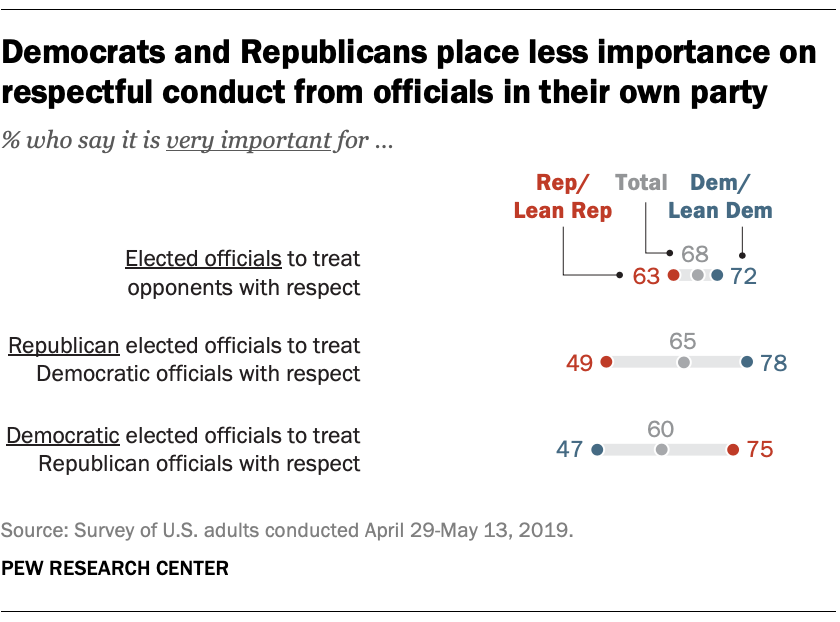
Republicans and Democrats overwhelmingly say it is very important for elected officials in the opposing party to treat officials from their own party with respect. They are much less demanding when it comes to members of their party treating the other side with respect, according to a new Pew Research Center study of political discourse in the United States.
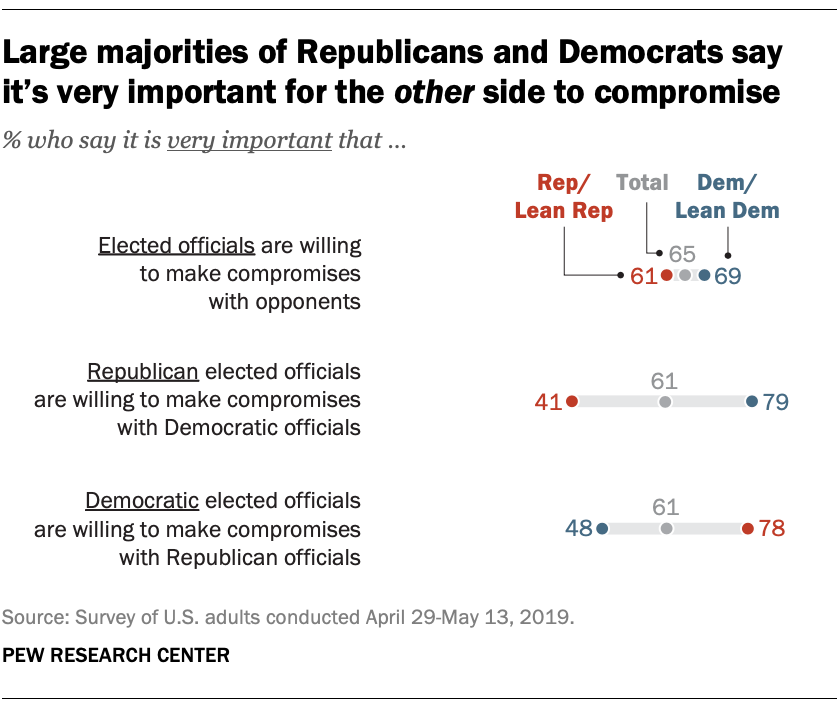
The study finds a similar pattern of opinion in views of political compromise: Republicans and Democrats both like the idea of compromise in principle and place great importance on the opposing party making compromises with members of their party. But much smaller shares say it’s very important for politicians in their own party to compromise.
These are just two of the many examples of Republicans and Democrats setting higher standards for the opposing party than for their own party, according to the new study. The gaps in views on the importance of respect are especially striking, given that 85% of the public – including nearly equal shares in both parties – says the political debate in this country has become less respectful in recent years.
A sizable majority of all U.S. adults (68%) say it’s very important that elected officials treat their political opponents with respect; another 24% say this is somewhat important. Democrats and Democratic-leaning independents (72%) are somewhat more likely than Republicans and Republican leaners (63%) to place high importance on this quality in politicians generally.
Yet both Republicans and Democrats place much more importance on officials from the other party acting respectfully toward political opponents than on members of their own party doing the same. Three-quarters of Republicans say it’s very important for Democratic officials to treat GOP officials with respect; only about half (49%) say it’s very important for Republican officials to be respectful toward Democrats.
Similarly, Democrats are 31 percentage points more likely to say it is very important for Republican elected officials to treat Democrats with respect than it is for Democratic officials to treat Republicans with respect (78% vs. 47%). When it comes to political compromise, majorities in both parties say it is very important that elected officials be willing to make compromises with their opponents to solve important problems.
But fewer than half of Republicans (41%) – including just a third of conservative Republicans – say it is very important for GOP elected officials to make compromises with Democrats. Democrats are slightly more likely than Republicans to value political compromise in principle. Still, only 48% of Democrats say it is very important for officials in their party to be willing to compromise with Republicans, including 42% of liberal Democrats.
In conclusion, we all have to put aside our differences and work together for the betterment of everyone if we want this country to succeed in the future.
Sources
"Trust and Distrust within America" - Pew Research Center
"Why Has America Become So Divided?" - Psychology Today
"How Corrupt is America's Judicial System?" - Seeker
"Partisans say respect and compromise are important in politics – particularly from their opponents" - Pew Research Center
Parallax Image Source


