Police Brutality
Police brutality was in use in the American press as early as 1872, when the Chicago Tribune reported on the beating of a civilian under arrest at the Harrison Street Police Station
Accountability
Accountability is a vital element of American policing. Both individual officers and law enforcement agencies should be held to account for their actions. Effective accountability procedures are essential if the police are to achieve their goals of lawfulness and legitimacy, as defined by The National Academy of Sciences.
Excessive Force
In making arrests, maintaining order, and defending life, law enforcement officers are allowed to use whatever force is “reasonably” necessary. The breadth and scope of the use of force is vast—from just the physical presence of the officer to the use of deadly force. Violations of federal law occur when it can be shown that the force used was willfully “unreasonable” or “excessive.”
False Arrest and Obstruction of Justice
The Fourth Amendment of the U.S. Constitution guarantees the right against unreasonable searches or seizures. A law enforcement official using authority provided under the color of law is allowed to stop individuals and, under certain circumstances, to search them and retain their property. It is in the abuse of that discretionary power—such as an unlawful detention or illegal confiscation of property—that a violation of a person’s civil rights may occur.
SEC. 210402. DATA ON USE OF EXCESSIVE FORCE.
(a) ATTORNEY GENERAL TO COLLECT–The Attorney General shall, through appropriate means, acquire data about the use of excessive force by law enforcement officers. (b) LIMITATION ON USE OF DATA–Data acquired under this section shall be used only for research or statistical purposes and may not contain any information that may reveal the identity of the victim or any law enforcement officer. (c) ANNUAL SUMMARY–The Attorney General shall publish an annual summary of the data acquired under this section.
Quote
“Police violence disproportionately impacts young people, and the young people affected are disproportionately people of color,” Anthony Bui of the David Geffen School of Medicine at the University of California, Los Angeles and colleagues wrote.
Statistics
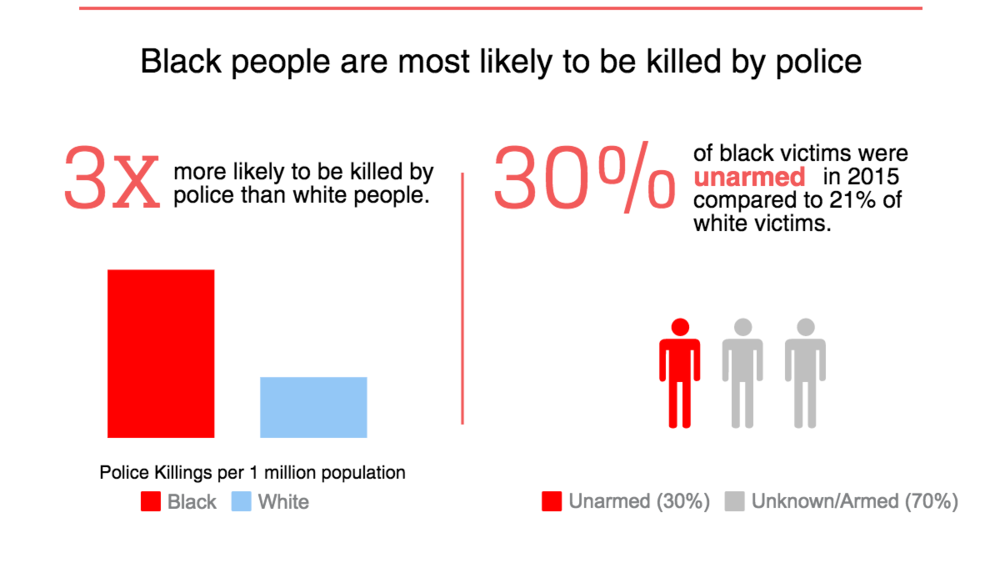
- Black people are most likely to be killed by police.
- Less than 1 in 3 black people killed by police in America in 2014 were suspected of a violent crime and allegedly armed.
- 99% of cases in 2015 have not resulted in any officer(s) involved bing committed of a crime.
- 84% of police officers have stated in a recent survey that they have directly witnesses a fellow officer using more force than was necessary. (US Department of Justice)
- 93.7% of the victims of police brutality that involve the discharge of a weapon are men.
- People who are African-American/Black are twice as likely to be killed by a police officer while being unarmed compared to a Caucasian/White individual.
- 1 in 4 people who are killed by law enforcement officials in the United States are unarmed.
- Depending on where you live, it plays a factor on the number of black people getting shot or killed.
- The Dallas police department has implemented mandatory de-escalation techniques as part of their officer training. As a result of this effort, the police department experienced a 60% drop in the number of complaints against police from 2009-2014. It also resulted in a 30% drop in police assaults and a 40% drop in police shootings.
- 97% of the cases of police brutality that were tracked in 2015 did not result in any officer involved being charged with a crime.
- 39% of African-American/Black individuals who were killed by police during their arrest were not attacking when they were killed from 2012 data.
Example of The Necessary Use of Force
In Hong Kong Protests, Tear Gas and Violence End a Period of Calm Aug. 24, 2019
The protest started due to China not allowing Hong Kong becoming Pro-Democracy. the The use of force was needed since protestors started fires and attacked officers with bricks.
Sources:
42 Shocking Police Brutality Statistics
In Hong Kong Protests, Tear Gas and Violence End a Period of Calm
Copyright © 2019 Lillian Ngo Information from Indicated Sources